Associate Fellow, Manohar Parrikar IDSA, Dr Anand Kumar’s article ‘Imperatives of Dhaka’s Indo-Pacific outlook’ has been published in ‘The Statesman’ on 12 May 2023.
Though this is a welcome development for a country which was considered as a basket case at the time of its liberation, it has also presented new challenges especially in the economic arena, says Dr Kumar.
Associate Fellow, Manohar Parrikar IDSA, Dr Anand Kumar’s article ‘India for a stable and friendly Govt in Nepal’ has been published Daily Excelsior on 26 December 2022.
Associate Fellow, Manohar Parrikar IDSA, Dr Anand Kumar’s article ‘In the absence of water-sharing deal, India should help Bangladesh with Teesta water management’ has been published in South Asia Monitor on 23 September 2022.
Building a reservoir on the Teesta will help Bangladesh create a climate-resilient infrastructure which will be useful in better managing the common river water, says Dr Kumar.
The United Nations peacekeeping operations (UNPK) have been evolving continuously and Bangladesh as a country has been playing an important role in it. The country wants to remain a dominant contributor to UNPK even in future as the participation brings several advantages in military, diplomatic, economic and social arena. Meanwhile, it has also been realised that to make the UNPK more effective, women have to play an important role as there are certain functions which women can perform better.
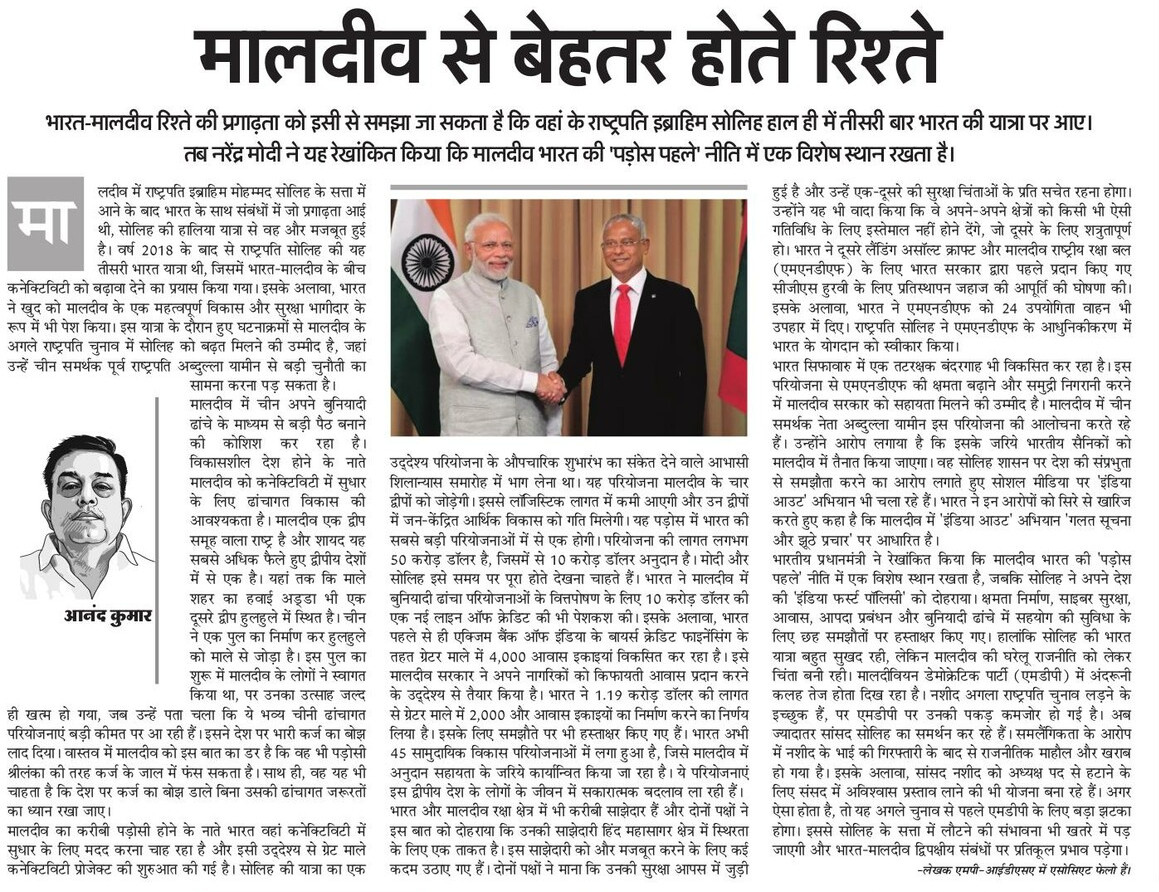
Associate Fellow, Manohar Parrikar IDSA, Dr Anand Kumar’s article ‘India-Maldives ties set for consolidation, but China remains elephant in the room’ has been published in South Asia Monitor on 12 August 2022.
The India-Maldives bilateral relationship that has been on upswing after President Ibrahim Mohamed Solih came to power was further strengthened by his latest visit to India. This was the third visit of President Solih to India since 2018 where an attempt was made to boost connectivity both within the Maldives and between India and the Maldives, says Dr Kumar.
Associate Fellow, Manohar Parrikar, Dr Anand Kumar’s opinion Piece ‘How the West’s sanctions on Russia are fuelling political and economic instability–and resentment–in South Asia’, has been published in South China Morning Post, on 20 July 2022.
Associate Fellow, Manohar Parrikar IDSA, Dr Anand Kumar’s article ‘Why India counts in Maldivian political tussle’ has been published in ‘The Tribune’ on 14 July 2022.
Associate Fellow, Manohar Parrikar IDSA, Dr Anand Kumar’s article on India-Afghanistan relations ‘Renewed ties’ has been published in ‘The Statesman’ on 29 June 2022.