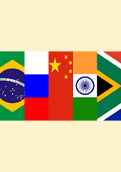
The monograph portrays to understand and contribute to the strategic analyses of foreign, security and economic policy issues that are attached to the rise of BRICS. This is not only a study about BRICS per se; but is also about China and India, the two most vital powers of this grouping. This study has been written in Indian context, and has tried to delve into the China-India course within BRICS.
The controversy regarding President Vladimir Putin’s participation in the BRICS Summit at Johannesburg due to an arrest warrant by the International Criminal Court highlights the geopolitical overtones and inadequacies of the ICC in the contemporary world.
Russia India and China are paying more and more attention to international security issues. They have developed a broad common security agenda via cooperation through two international institutions created by them. BRICS serve as a mechanism for promoting their economic security interests, SCO is focused on traditional security issues. Along with forming a common position on main international security problems, Russia, India and China act as great powers and disagree on certain security matters mostly of regional and bilateral nature.
This article examines the evolution of Russia’s policy towards BRICS from the time of its formation as a group of four countries in 2006 to the present. The authors analyse the main political objectives that guided Moscow in initiating the creation of this format and in developing it in subsequent years. The article argues that, with Russia as a participant, the character of the organization has undergone major changes, due both to the changing international situation and fundamental changes that the foreign policy of Russia itself has undergone since 2014.
Having overcome its ‘middle-power’ complex during the centre-left governments, Brazil obtained a relatively robust position in international politics as global power, siding with G-20, BRICS and other multilateral bodies. However, since the 2018 presidential elections Brazil has been undergoing a visible shift in its foreign policy towards more alignment with the US and the West that questions its traditional international autonomy, multilateralism, South-South engagement and environmental activism.
This article attempts to understand BRICS from the perspective of a multi-polar world order and the role played by India at the BRICS. Specifically, the article looks at the implication that BRICS has for future of multilateralism, promoting new institutional delivery mechanisms, upholding the space for development and equity, and highlights India’s contribution to the shaping of the BRICS agenda.
Brazil and Russia rank first and second globally by the amount of renewable freshwater resources. Despite the significant challenges to municipal water use and water quality for the population, even in the timespan of 30 years these countries will be most protected from water stress. At the same time, China and India - countries with vast water resources, meet growing water challenges being the first and second in terms of world population and the world’s first and third economy according to PPP with prospects for further growth.
This article examines the preconditions and reasons for interaction between BRICS countries in the fields of science, research and university education. It analyzes the particular ways in which the member countries develop and coordinate their positions in these areas. It also reviews and evaluates the practical experience gained from cooperating on scientific and technological research and innovation (STRI), and the functioning of the BRICS Network University, and considers the prospects for further joint work in these areas.