

Call for Papers
Journal of Defence Studies
Special Issue: The Year of Reforms: Reshaping India’s Defence for the Decade Ahead
Deadline for Manuscript Submission: 1 April 2026
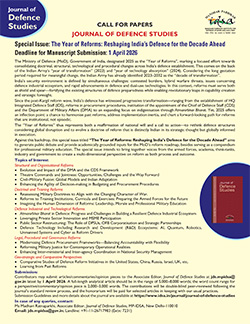 The Ministry of Defence (MoD), Government of India, designated 2025 as the “Year of Reforms”, marking a focused effort towards consolidating doctrinal, structural, technological and procedural changes across India’s defence establishment. This comes on the back of the Indian Army’s “year of transformation” (2023) and “year of technology absorption” (2024). Considering the long gestation period required for meaningful change, the Indian Army has already identified 2023–2032 as the “decade of transformation”.
India’s security environment is defined by simultaneous challenges: contested borders, hybrid warfare threats, issues concerning defence industrial ecosystem, and rapid advancements in defence and dual-use technologies. In this context, reforms must serve both as shield and spear—fortifying the existing structures of defence preparedness while enabling revolutionary leaps in capability creation and strategic foresight.
Since the post-Kargil reform wave, India’s defence has witnessed progressive transformation—ranging from the establishment of HQ Integrated Defence Staff (IDS), reforms in procurement procedures, institution of the appointment of the Chief of Defence Staff (CDS) and the Department of Military Affairs (DMA) to an expanding focus on indigenisation through Atmanirbhar Bharat. Yet, 2025 offers an inflection point: a chance to harmonise past reforms, address implementation inertia, and chart a forward-looking path for reforms that are institutional, not episodic.
The “Year of Reforms” thus represents both a reaffirmation of national will and a call to action—to rethink defence structures considering global disruption and to evolve a doctrine of reform that is distinctly Indian in its strategic thought but globally informed in execution.
Against this backdrop, this special issue titled “The Year of Reforms: Reshaping India’s Defence for the Decade Ahead” aims to generate public debate and provide academically grounded inputs for the MoD’s reform roadmap, besides serving as a compendium for professional military education. The special issue intends to bring together voices from the armed forces, academia, think-tanks, industry and government to create a multi-dimensional perspective on reform as both process and outcome.
Topics of Interest
Structural and Organisational Reforms
- Evolution and Impact of the DMA and the CDS Framework
- Theatre Commands and Jointness: Opportunities, Challenges and the Way Forward
- Civil–Military Fusion: Global Models and Indian Adaptation
- Enhancing the Agility of Decision-making in Budgeting and Procurement Procedures
Doctrinal and Training Reforms
- Reassessing Military Doctrines to Align with the Changing Character of War
- Reforms to Training Institutions, Curricula and Exercises: Preparing the Armed Forces for the Future
- Imagining the Human Dimension of Reforms: Leadership, Morale and Professional Military Education
Defence Industrial and Technological Reforms
- Atmanirbhar Bharatin Defence: Progress and Challenges in Building a Resilient Defence Industrial Ecosystem
- Leveraging Private Sector Innovation and MSME Participation
- Public Sector Restructuring: The Role of DPSUs, OFB Corporatisation and Strategic Partnerships
- Defence Technology Including Research and Development (R&D) Ecosystems: AI, Quantum, Robotics, Unmanned Systems and Cyber as Reform Drivers
Legal, Procedural and Governance Reforms
- Modernising Defence Procurement Frameworks—Balancing Accountability with Flexibility
- Reforming Military Justice for Contemporary Operational Realities
- Enhancing Inter-ministerial and Inter-agency Coordination in National Security Management
Geo-strategic and Comparative Perspectives
- Comparative Studies of Defence Reform Initiatives in the United States, China, Russia, Israel, UK, etc.
- Learning from Past Reforms
| Submission: Contributors may submit articles/commentaries/opinion pieces to the Associate Editor, Journal of Defence Studies at jds.mpidsa@gov.in latest by 1 April 2026. A full-length analytical article should be in the range of 5,000–8,000 words; the word count range for a perspective/commentary/opinion piece is 2,000–3,000 words. The contributions will be double blind peer-reviewed following the journal’s standard review process, and the honorarium will be paid for selected articles in keeping with our usual practices. Submission Guidelines and more details about the journal are available at https://www.idsa.in/journal/journal-of-defence-studies
In case of any queries, contact: Ms Madhavi Ratnaparkhi Email: jds.mpidsa@gov.in; Landline: +91-11-26717983 (Extn: 7231) |
Guidelines for Contributors
Sp. Issue: The Year of Reforms: Reshaping India’s Defence for the Decade Ahead
Manuscript submission: Articles ranging between 5,000 and 8,000 words and commentaries/perspective pieces of about 2,000–3,000 words may be sent to the Associate Editor, Journal of Defence Studies at jds.mpidsa@gov.in latest by 1 April 2026.
Format
- Manuscripts need to be submitted in MS Word format (2003/2007/newer versions). The text (including notes) should be typed in Times New Roman, 12 pt with 1.5 line spacing and standard margins.
- An abstract of about 100–150 words and 5–6 keywords should be provided in the articles.
- British spellings with ‘s’ variant should be used, i.e., ‘analyse’, ‘organise’, ‘specialisation’, ‘labour’,
- Single quotation marks should be used consistently and use double quotation marks for indicating quoted matter within
- Tables/Figures/Maps/Images should be numbered sequentially, with appropriate captions, source details and call-outs in the
References
All citations/references to others’ works should be clearly mentioned in the notes (footnotes), with a corresponding note cue in the text. The format is mentioned below.
Book: Liang Zhang, Andrew J. Nathan, Perry Link and Orville Schell, The Tiananmen Papers: The Chinese Leadership’s Decision to Use Force Against their Own People—In Their Own Words, Public Affairs, New York, 2001.
Edited Volume: Ashley Tellis, Mercy Kuo and Andrew Marble (eds), Strategic Asia 2008–09: Challenges and Choices, National Bureau of Asian Research, Seattle, 2008.
Chapter in an Edited Volume: T. Jayaraman, Tejal Kanitkar and Mario D’Souza, ‘Equity and Burden Sharing in Emission Scenarios: A Carbon Budget’, in Navroz Dubash (ed.), Handbook of Climate Change and India: Development, Politics and Governance, Oxford University Press, New Delhi, 2012, pp. 140–46.
Journal Article: Arthur A. Stein, ‘Coordination and Collaboration: Regimes in an Anarchic World’, International Organization, Vol. 36, No. 2, 1982, pp. 99–114.
Web Reference: Vladimir Radyuhin, ‘INS Vikramaditya Begins Sea Trials’, The Hindu, 8 June 2012, available at http://www.thehindu.com/news/international/article3503982.ece, accessed on 8 June 2012.


