India-Pakistan Relations

Operation Sindoor: 88 Hours That Redefined Deterrence

The Pahalgam terrorist attack of April 2025 and the Indian Army’s subsequent action were a matter of great public and strategic debate. The focus was on how the operation was conducted, its military outcome, and its implications for the relationship between India and Pakistan. The book, Operation Sindoor: 88 Hours that Redefined Deterrence by Maj. Gen. Dhruv C. Katoch and Lt. Gen. Raj Shukla, seeks to move focus away from the immediate events. The authors are not only trying to report on the events of the 88 hours of the Op but also gauge how the operation may have sparked a larger shift in India’s strategic thinking. This is the book’s overarching aim that distinguishes it from many contemporary accounts of the security crises. Those who have been reading the text with the hope of a regular military history may be surprised that before it reaches the actual Operation Sindoor, too much attention has been devoted to the historical development of Jammu and Kashmir and to Pakistan’s ideological trajectory. This is significant because it reflects the authors’ understanding of the crisis. The Pahalgam terrorist attack of 2025, in their opinion, is part and parcel of the journey of political tension, identity building and conflict between India and Pakistan since 1947.
Ravi Shankar Raj | July-August 2026 | Strategic Analysis

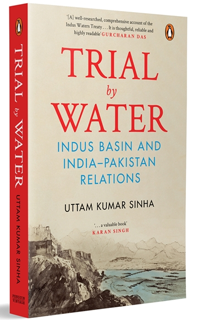
Trial by Water: Indus Basin and India-Pakistan Relations

  • Publisher: Penguin Random House India
In 1947, the Indian subcontinent was partitioned, and Pakistan was born. A shared heritage, a composite culture and centuries-old bonds between people, all seemed to vanish overnight. Nowhere was this rupture more profound than in the Indus Basin—once a unified lifeline of the region, now fragmented by sovereign borders, its rivers flowing through two nations immediately at odds with each other. The Indus Waters Treaty was signed in 1960, proving that even bitter adversaries could cooperate over shared resources. Yet, it never brought lasting peace. The treaty was suspended by India in April 2025 as a punitive measure in the wake of the Pahalgam terror attack, and its future remains shrouded in uncertainty. Can it still endure and adapt? Perhaps the time has come for a new arrangement—one that is not just inevitable but essential. This book traces the turbulent history of the Indus Basin and examines how the Indus Waters Treaty has been shaped by the region’s ever-evolving political dynamics. It explores the role of key leaders on both sides, as well as external pressures, in shaping and reshaping one of the world’s most critical transboundary water agreements. The Indus Basin has been a witness to conflict, compromise and survival. And if you seek to understand the true nature of India–Pakistan relations, start with the rivers that bind them. Trial by Water leads us in that direction.
  • ISBN: 9780143471028,
  • Price: ₹ 599/-
  • E-copy available

Uttam Kumar Sinha | July 17, 2025 | Book

Whither Pakistan? Growing Instability and Implications for India

  • Publisher: Institute for Defence Studies and Analyses

Pakistan has invariably evoked a great deal of interest among India’s strategic affairs community. Because of historical, geographical, economic and cultural linkages, developments in the neighbourhood have important implications for India’s politics, economy and security. The basic argument that flows from the report is that Pakistan is likely to remain unstable because of inherent weaknesses in its political, economic and security policies.

  • ISBN 81-86019-70-7,
  • Price: ?. 299/-
  • E-copy available

Water Security for India: The External Dynamics

  • Publisher: Institute for Defence Studies and Analyses

India is facing a serious water resource problem and as trends suggest, it is expected to become 'water stressed' by 2025 and 'water scarce' by 2050. Premised on this, this IDSA Report raises fundamental questions about the forces driving water demand and the political dynamics of riparian relations, both in terms of hindrances and opportunities, amongst states in the subcontinent.

  • ISBN 81-86019-83-9 ,
  • Price: ₹ 350/-
  • E-copy available

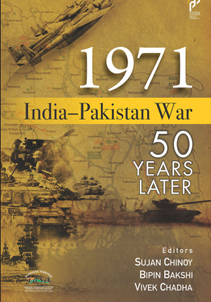
1971 India-Pakistan War: 50 Years Later

  • Publisher: Pentagon Press
India’s decisive and historic victory in the 1971 India–Pakistan War is considered to be one of the landmark geopolitical events in the history of the sub-continent. One of the shortest wars in world history, fought for a mere 13 days, the lightning campaign brought about a change in the world’s perception of India, marking its recognition as an important regional power.

The combined impact created by the resolute people of Bangladesh and the professional approach of the Indian state, successfully converted a catastrophe of epic proportions into a victory of the people, won through their stoic resolve and the professionalism of the armed forces.

There have been a number of books, memoirs and articles over the years that have documented first-person and academic accounts of events that marked this period of history. Not surprisingly, most were written during the period succeeding the war and after the birth of Bangladesh. This book is an attempt to evaluate events with the benefit of a five-decade time lapse. In doing so, the focus remains firmly on the military aspects of the war, accompanied by a brief account of political events, diplomacy, influence of major powers, public perception and the role of Mukti Bahini.

  • ISBN:9789390095698 ,
  • Price: ? 1495
  • E-copy available