Air Cmde (Retd) Ramesh Phadke was Advisor, Research at Institute for Defence Studies and Anaysis, New Delhi. <a href="/profile/rphadke">Click here for detailed profile</a>
It is time India devised appropriate tactics to meet the current threat. It is imperative that the armed forces prepare for ‘the most likely scenario’ rather than ‘the worst case scenario’. But to be fair, this can only be done when there exists a clear national military policy/strategy.
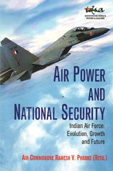
In over a century since the first manned flight, air power has made spectacular progress. Every conflict since World War II has seen an increasingly bigger role of air power, but despite this, to a general reader, air power continues to be esoteric. The study highlights major air power lessons of all the major conflicts, and explains air power roles and missions. It frankly yet fairly discusses the somewhat contentious subject of air power in support of surface forces and traces the IAF’s contribution in war and peace in the last 68 years since independence. It critically examines if use of air power in the Indian subcontinent is indeed escalatory.
The 1965 Indo-Pak War came when India was in the midst of a major military expansion. India did not want to escalate matters when Pakistani forces invaded Kutch in April 1965 and accepted a ceasefire with British mediation. Although the government allowed the use of Indian Air Force (IAF) combat aircraft on 1 September 1965, action remained localised to the Chhamb area for five days. This was primarily because of India’s desire to avoid all-out war. IAF was used for counter air, air defence, and in support of the ground forces.
Instant, hard and yet calibrated military, diplomatic and political response is needed since mere warnings and protestations have proved grossly inadequate to change Pakistan’s behaviour.
In the ongoing debate on the 1962 War, two issues have not been adequately addressed: the myth that the Indian Army had not provided viable military options, and the reasons for the non-use of the combat potential of the Indian Air Force.
In the absence of a sustained and visible commitment to rapid indigenisation, India’s dependence on foreign suppliers for its defence needs will only increase and India will sadly remain a ‘knowledge colony’.
The range, speed, armament carrying capacity and the ability to accurately deliver a variety of weapons against different targets make the current IAF fleet of just over 32 squadrons far more formidable than when the IAF had almost 39.5 squadrons.
The Rafale’s upkeep and maintenance would demand a very high level of training and skills both by the pilots and technical personnel. Above all, stupid mistakes must be avoided by bringing about a fundamental change in our outlook to peacetime operations.
International economic circumstances are propitious for India and Indian defence companies to strike deals that would help reduce dependence on foreign sources for defence needs.





Defence Budget 2016-17: A Clear Message to the Armed Forces
It is time India devised appropriate tactics to meet the current threat. It is imperative that the armed forces prepare for ‘the most likely scenario’ rather than ‘the worst case scenario’. But to be fair, this can only be done when there exists a clear national military policy/strategy.